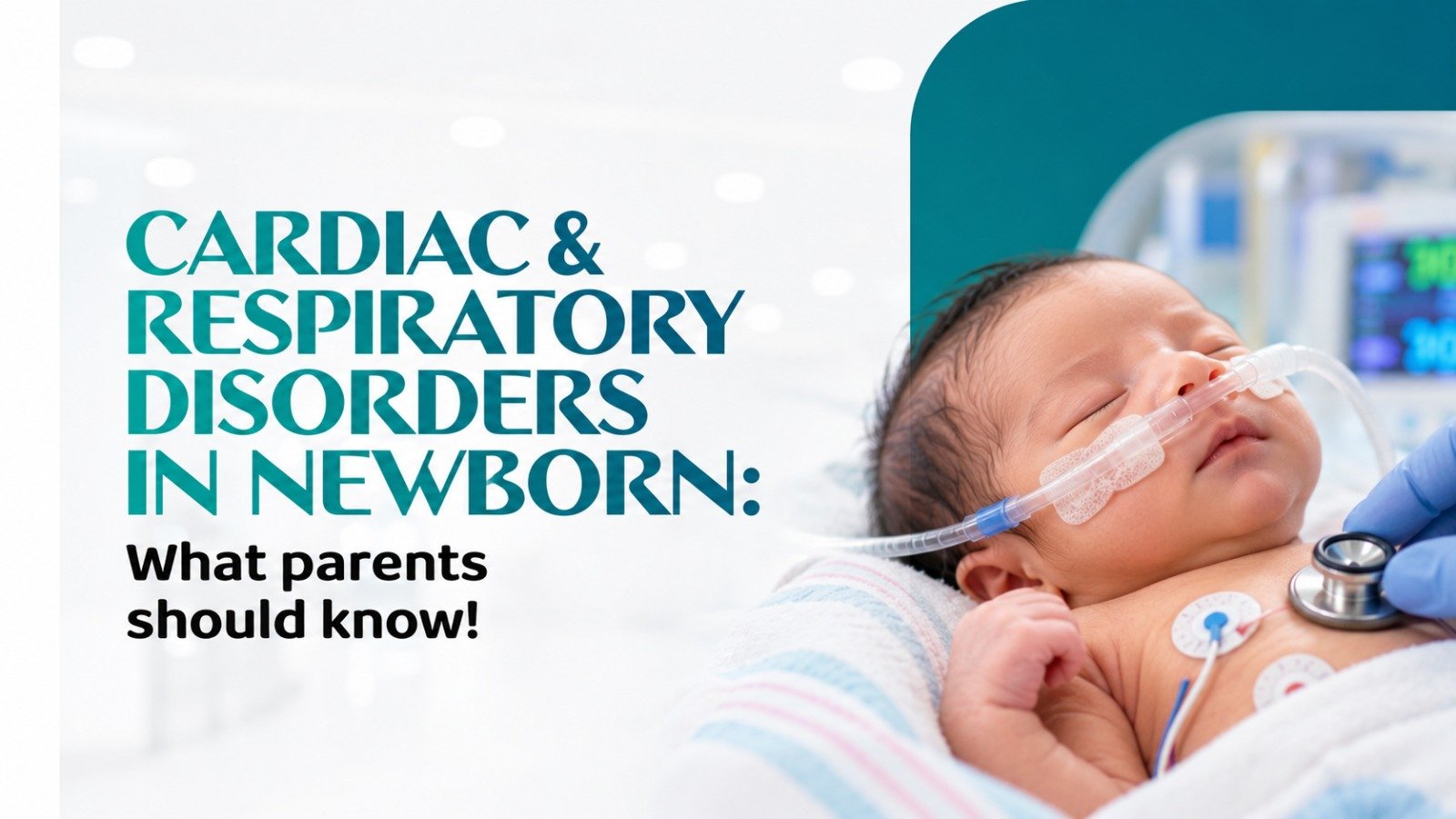
Cardiac and Respiratory Disorders in Newborns: What Parents Should Know
A newborn’s first cry can feel like the biggest relief in the world.
But what if your baby starts breathing unusually fast? What if the lips look slightly blue? Or what if the doctor says, “We need to monitor your baby’s heart and breathing closely”?
For parents, these moments can be terrifying.
The good news is that neonatal medicine has come a long way. With early recognition, continuous monitoring and specialised newborn care, many cardiac and respiratory conditions can be identified and treated at the right time.
What Are Cardiac Disorders in Newborns?
A newborn’s heart begins working independently from the moment of birth, but some babies are born with structural or functional heart problems.
These may be called congenital heart defects.
Some are mild and may only require observation. Others need medicines, specialised monitoring or procedures.
Examples include:
- Ventricular septal defect (VSD)
- Atrial septal defect (ASD)
- Patent ductus arteriosus (PDA)
- Coarctation of the aorta
- Tetralogy of Fallot
- Transposition of the great arteries
Not every heart condition produces obvious symptoms immediately after birth.
That is why newborn cardiac screening and careful clinical examination can be important.
What Signs May Suggest a Heart Problem?
Parents may notice:
- Bluish lips or skin
- Fast breathing
- Difficulty feeding
- Excessive sweating during feeds
- Poor weight gain
- Unusual tiredness
- Persistent low oxygen levels
However, these symptoms can also occur with respiratory or other neonatal conditions.
One symptom does not equal one diagnosis.
A neonatologist or paediatric cardiologist may recommend further evaluation, including an echocardiogram, depending on the baby’s clinical findings.
What About Respiratory Disorders?
Breathing is one of the biggest transitions a newborn makes.
After birth, the lungs must rapidly adapt from a fluid-filled environment to breathing air.
Sometimes that transition does not happen smoothly.
Newborns can develop conditions such as:
Transient Tachypnea of the Newborn (TTN) – temporary rapid breathing caused by delayed clearance of lung fluid.
Respiratory Distress Syndrome (RDS) – more commonly associated with premature babies because their lungs may not have enough surfactant.
Meconium Aspiration Syndrome – when a baby breathes meconium-stained fluid into the lungs around the time of birth.
Neonatal pneumonia or infection – infections can also cause breathing difficulty and require prompt treatment.
How Do Doctors Know What Is Happening?
This is where NICU monitoring becomes extremely important.
The neonatal team may continuously monitor:
- Oxygen saturation
- Heart rate
- Respiratory rate
- Blood pressure
- Temperature
Depending on the situation, the baby may need blood tests, chest imaging, echocardiography or other investigations.
The medical team then combines these findings with the baby’s symptoms and examination to determine the appropriate treatment.
Can Heart and Lung Problems Look Similar?
Yes.
This is one reason parents should not try to diagnose a newborn’s condition based on symptoms alone.
Fast breathing, for example, may occur because of a lung problem, heart problem, infection or other medical condition.
Similarly, low oxygen saturation can have multiple causes.
In some babies, cardiac and respiratory disorders can even occur together, making specialist neonatal assessment particularly important.
What Treatment Might a Newborn Need?
Treatment depends entirely on the diagnosis.
Some babies need only observation and supportive care.
Others may require:
- Oxygen therapy
- CPAP or other respiratory support
- Medicines
- IV fluids
- Feeding support
- Antibiotics when infection is suspected or confirmed
- Cardiac evaluation
- Surgical or catheter-based intervention in selected heart conditions
The aim is not to use the most treatment.
The aim is to provide the treatment the baby actually needs.
When Should Parents Seek Immediate Help?
If your newborn has difficulty breathing, persistent rapid breathing, grunting, severe chest retractions, blue/grey lips or skin, pauses in breathing, poor feeding or unusual sleepiness, seek urgent medical attention.
Newborns can deteriorate quickly, so early assessment matters.
A Small Baby Can Have a Big Medical Story
A newborn cannot tell you, “Something doesn’t feel right.”
Sometimes, the only clues are in their breathing, feeding, colour or behaviour.
That is why newborn observation matters so much.
Early detection + expert neonatal care + timely treatment can make a crucial difference.
And for parents, the most important thing to remember is this:
Don’t panic. Don’t ignore. Get the baby assessed.